
The EU Is Forcing Google to Redesign: Why Comparison Portals Now Rank Ahead of Your Offer
For many businesses, the equation was stable for years: rank well, get clicks, turn visitors into customers on your own website. Whoever stood at the top got the attention. That equation no longer holds unchanged. Since the end of September, Google has been redesigning shopping and travel searches across Europe — forced by the European Commission. Comparison portals and intermediaries are moving ahead of direct providers, and Google itself is warning of consequences for local businesses.
The real story sits one level deeper: the click was never guaranteed, but the space between ranking and click used to belong to your own website. That space increasingly belongs to intermediaries. Anyone who keeps optimizing only for rankings is optimizing for a results page that no longer shows only your own door.
What happened — in three sentences
The European Commission fined Google EUR 890 million in July 2026 for breaches of the Digital Markets Act. 430 million of that covered what the Commission sees as the unlawful preferencing of Google’s own services in Search. Google had to change how its results page is presented — the 60-day implementation window expired at the end of September, and since then the redesign is visible to every user in Germany. Netzwelt documents the new formats from a user’s perspective.
The new formats: gathering spots for intermediaries, side seats for providers
For businesses, what matters is what the new results page looks like. Google is introducing two areas for this: so-called Aggregator Units and Supplier Units.
Aggregator Units: the new first stop. Here Google bundles offers from intermediaries, price comparison services, and metasearch engines. A prominently placed service like Booking.com or Expedia can be displayed in detail — with prices, photos, and reviews. Further providers can be selected afterwards. Businesses that themselves broker or compare can profit from this. Businesses that themselves deliver do not appear here.
Supplier Units: less prominent, but present. Direct providers — individual hotels, airlines, local shops — still appear in Search, but in a less prominent position. That is the core of the change: not disappearance, but reordering. The results page shifts from the provider to the intermediary.
The new presentation appears mainly on queries with buying or booking intent — hotels, flights, products, provider searches. Search for “Lufthansa” today and comparison portals like fluege.de and Opodo appear prominently right below the first result. Which portals appear concretely is still decided by the algorithm — Check24 and Idealo are considered likely winners, but nothing is guaranteed.
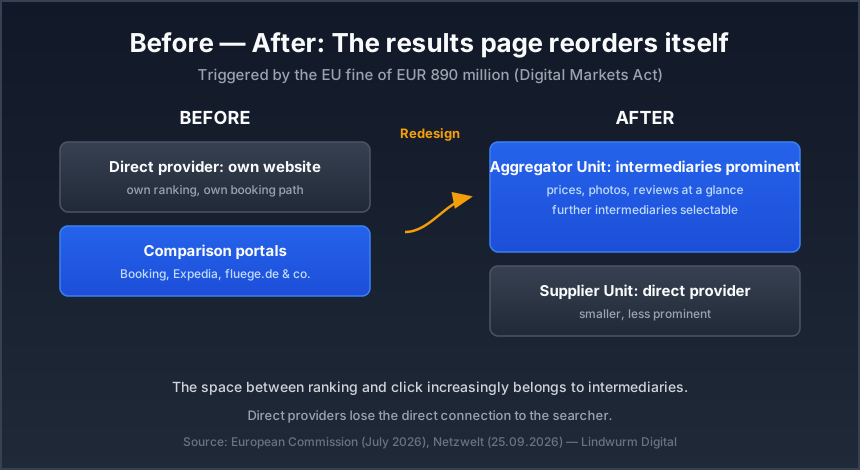 The new results page reorders: comparison portals now sit prominently, direct providers move down.
Why the EU acts — and why Google disagrees
Behind the redesign stands the Digital Markets Act. The Commission concluded that Google had preferred its own services in its search results over competing services — preventing exactly this kind of self-preferencing is the core of the law. 430 of the 890 million euros concerned self-preferencing in Search; the remaining 460 million concerned steering restrictions in the Play Store.
Google disagrees — and that is more than a footnote. Nick Fox, Senior Vice President for Search, told Reuters the changes make the experience worse for European users. Online intermediaries in particular would profit, while local businesses would receive fewer direct visitors. Google points to its own studies: free direct booking visits to European business websites had already dropped by roughly 30 percent due to earlier DMA changes. In a test in Germany, Belgium, and Estonia, hotel traffic fell by more than ten percent after Google replaced expanded hotel information with simple web links. The reactions of millions of test users were also predominantly negative.
Two things matter about these numbers. First: they are Google’s own numbers — the company is an interested party in this matter, and the European Commission assesses the same events in opposite terms. Second: even if you take them at face value, they describe exactly the scenario businesses must prepare for — fewer direct visits from Search, more routes through intermediaries. The direction is undisputed; only the magnitude is contested.
What this means for businesses — honestly assessed
Not every business is affected equally. Those found purely for information — trades and crafts, consulting, local services without a booking flow — will notice little at first. The redesign becomes clearly noticeable where buying and booking intent is in play: hotels, flights, rentals, insurance, product searches. There, your own website now explicitly competes with intermediaries that Google places structurally ahead.
The inconvenient truth: a good spot in the Supplier Units does not replace a direct click. Whoever builds their revenue on direct bookings now needs two answers: how to stay visible in the new results page, and how to become more independent of it.
What does it cost to ignore this?
The honest question is not whether Google is taking visitors from you — the results page belongs to Google. The question is what it costs to build your strategy on the assumption that nothing will change.
The creeping effect is more dangerous than the one-time traffic drop. Every visitor who arrives via a comparison portal is a visitor with an intermediary expectation: they compare prices, not providers. The relationship forms with the portal, not the business — and with it the commission, the data sovereignty, and the repeat business. Whoever does not push back against this trend turns their website from a customer channel into a business card that gets checked before booking at the portal.
Three levers that matter now
Turn every direct visit into a conversion. As direct clicks become scarcer, the value of each one rises. A website that enables inquiries, bookings, or offers clearly and without detours gets more out of the remaining traffic. This is not an SEO trick — it is conversion work: clear offers, visible prices where possible, an inquiry path without friction.
Communicate direct benefits. Whoever books or inquires via your own website should have a reason — a better price, more personal advice, faster response, extras that portals do not offer. A direct benefit is the counterpart to the intermediary expectation.
Build your own channels instead of mourning a results page. Dependence on a platform was a risk before the DMA; now it is visible. Newsletters, existing customer relationships, referrals, well-maintained directory listings — channels that no one can reorder for you. If you want to be visible in AI search, see our thoughts on AI agents and Machine Experience.
A five-minute self-check
Before commissioning anyone, you can do a first assessment yourself. Search Google for your most important product or service — the way a customer with intent to buy or book would search. Watch for four things:
- Where do you appear? Above or below the comparison portals? Not at all anymore?
- What does the surface above your result show? If prices, photos, or booking buttons from intermediaries appear there, you are no longer competing only with other websites — but with Google’s new sales surface.
- What does a user see who clicks you directly? Do they find your offer, a price, or at least the next step within ten seconds? Or do they land on a homepage that explains once more who you are?
- Where do your visitors come from today? One look at your analytics suffices: what share of your inquiries comes from search engines — and how much from returning visitors, referrals, and direct access?
If that last question reveals that almost everything runs through Google, you already have the most important answer: that is where the risk lies, and that is where the work begins.
Common mistakes
Panic-optimizing for the new formats. Nobody currently knows how Google ranks the Aggregator selection. Anyone now hearing quick promises about “dominating” the new formats is buying smoke.
Taking the numbers at face value. Google’s 30-percent warning and the EU’s counter-position are two interested portrayals of the same event. Building decisions on either one without checking your own data is negligent.
Only reacting instead of improving your own position. The redesign affects the results page — not the quality of your offer, not your customer relationships, not your website. Whoever only reacts to Google keeps playing on someone else’s field.
Conclusion: The click was never yours — the relationship is
The EU is enforcing what was long overdue: more competition on a results page controlled by a gatekeeper. For direct providers this feels like loss at first — and short-term it is, especially in booking businesses.
The right response is neither complaint about Google nor hope for a rollback. It reads: count every direct visit and turn it into a customer, create direct benefits that intermediaries cannot offer, and build channels that no corporation can reorder. Platform dependence was never a strategy — only a habit. The DMA turns it into a measurable risk.
If you would like to assess how your offer stands under the new search formats and where your website gets more out of the remaining direct visits, let us talk about it in a non-binding initial conversation.
Related posts: When AI Agents Read Your Website | Google Core Updates and AI Content | AI in Web Design
Lindwurm Digital GmbH — Web development and digital solutions.