
When AI Agents Read Your Website: Why SEO in 2026 Is No Longer Built for Humans Alone
The next major shift on the web is not that companies publish more AI-generated text. That is only the noisy surface. The more important point is this: machines increasingly read a website before a human even decides whether to visit it.
Google is moving search and shopping toward more agentic systems. Heise reported from Google I/O 2026 on a cross-merchant Universal Cart; W&V framed the shift as Google moving from a directory-like guide toward an answer engine. At the same time, the debate around non-human traffic is becoming more concrete. Golem summarized a Cloudflare analysis with the headline that bots are overtaking human web traffic.
For companies, this does not mean that human visitors no longer matter. It means the website now has a second readership. Alongside real people, search systems, AI assistants, crawlers, comparison tools, and internal agents need to understand what a company offers, who it is for, which evidence supports it, and what a sensible next step looks like.
Classic SEO is not enough for that. The missing layer is Machine Experience: the experience a website creates for machine readers.
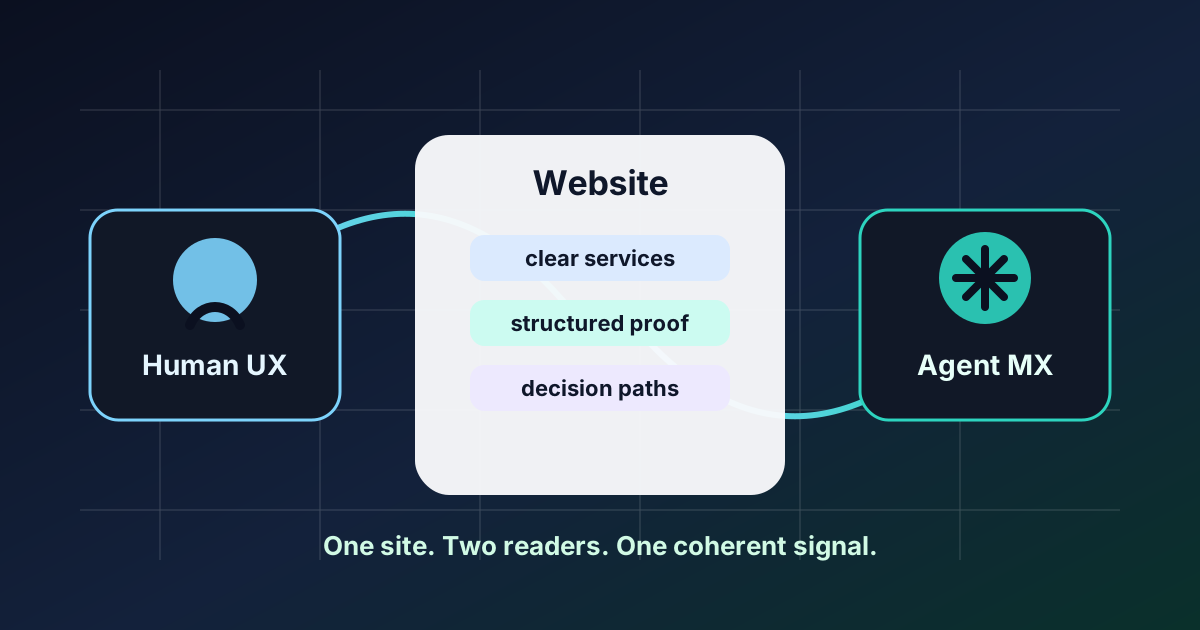 Original diagram: strong websites do not serve two separate worlds. They make the same truth understandable to humans and machines.
What Machine Experience means
User Experience asks: can a human quickly find orientation, trust, and the next step? Machine Experience asks: can a system reliably read the structure, meaning, and credibility of a website?
That sounds technical, but it is a business issue. If an AI assistant compares providers for a user, it needs clear signals: what is the service? Which target group does it fit? What are the limits? What evidence exists? Is the content current? Are there structured data, clear page roles, and consistent internal links?
A website can look modern and still be weak for machine readers. The reverse is also true: a technically clean page can feel cold and unconvincing for people. The task is not to choose between humans and machines. The task is to build a website clearly enough that both readers understand the same message.
That is the difference between Machine Experience and generic GEO language. Generative Engine Optimization describes how content might appear in AI answers. Machine Experience goes deeper: it asks whether the entire website is readable as a decision system.
Why this matters for business websites
Many B2B websites are still built for an older journey: someone searches on Google, opens three results, reads a little, and fills out a form. That journey still exists, but it is no longer the only one.
Today, the first filter can happen before the click. A decision-maker asks ChatGPT for suitable approaches. A team member lets an assistant compare vendors. A browser assistant summarizes pages. A search interface answers directly. A purchasing workflow extracts criteria from websites. In all of these cases, your website is not read like a person reads it. It is interpreted as data, structure, and evidence.
If that structure is missing, the website may not lose traffic immediately. It loses something more dangerous: classification. Systems may fail to understand why your offer is relevant. They may not mention you, may describe you badly, or may place you in a generic category where every provider sounds the same.
That is also a human problem. An unclear website forces visitors to do the work: what do they actually do? Is this relevant to us? Do they understand our problem? What happens after the enquiry? If an AI system fails on that structure, a human often fails too — just more quietly.
Five signals AI systems and humans both need
1. Clear service architecture
A strong website does not merely say “web development” or “digitalization.” It explains which problems are solved, which situations the offer fits, and where the boundaries are. Machines need those distinctions to classify content. Humans need them to avoid fighting through marketing fog.
2. Distinct page roles
The homepage, service pages, blog articles, case studies, contact page, and process pages should not all repeat the same generic copy. Each page needs a job. A blog article creates context. A service page makes an offer decidable. A contact page lowers friction. When page roles are clear, crawlers and AI systems can understand the structure more reliably.
3. Evidence instead of claims
“We are reliable” is not evidence. A precise explanation of how you work, transparent trade-offs, understandable technical decisions, and linked sources are stronger. AI systems do not evaluate brand magic. They find patterns, sources, entities, and contradictions. The cleaner the evidence, the better the chance of being classified correctly.
4. Structured data and semantic HTML
Schema.org, clean headings, descriptive URLs, accessible navigation, and consistent metadata are not glamorous. But they are the grammar machines use to read a website. If this layer is careless, your position becomes harder to interpret.
5. Decision paths instead of dead ends
Many websites explain a topic but do not move the reader forward. That frustrates humans. It is also a weak machine signal: there is no clear link between problem, offer, evidence, and next step. Strong websites build paths: from problem to solution, from solution to trust, from trust to enquiry.
The most common mistakes
The first mistake is treating Machine Experience as another SEO plugin. It cannot be pasted onto a broken structure. If services are unclear, duplicate pages compete with each other, and internal links feel random, a single CMS field will not fix the system.
The second mistake is writing only for AI answers. That quickly leads to inflated FAQ blocks, schema overuse, and copy that appears machine-friendly but tires human readers. Strong Machine Experience is not a trick. It is clarity.
The third mistake is blocking or allowing bot traffic without strategy. Both extremes can be wrong. Some machine access is useful, some is not. The technical handling of crawlers, robots rules, and AI crawler policies has to match the visibility strategy. If you block everything, you may disappear from relevant assistance systems. If you allow everything, you lose control.
The fourth mistake is content without ownership. AI-generated pages, old blog posts, unfinished service pages, and contradictory statements do not create trust. They create noise. Machines can scale noise, but they cannot turn it into a clear position.
The opportunity cost of ignoring this
The honest question is not: “What does Machine Experience cost?” The better question is: what does it cost when your website is online in 2026 but is not understood by the new readers?
It costs visibility in moments where users no longer search in the classic way. It costs trust when AI summaries describe your offer inaccurately or generically. It costs enquiries when people cannot see why they should speak to you specifically. And it costs time because every sales conversation has to restart with fundamentals the website should have clarified already.
This is not a panic story. It is an architecture question. Websites that are clearly structured do not only gain in AI systems. They become better for humans too: clearer navigation, better service pages, stronger internal linking, better decision logic.
What companies should check now
Do not start with a tool. Start with five questions:
- Could an outsider explain in two minutes what we offer and who it is for?
- Does every important page have a clear role in the decision journey?
- Are our key claims supported, current, and consistent?
- Is the technical structure clean enough for crawlers to understand the content reliably?
- Are there visible paths from information need to enquiry?
If several answers are uncertain, this is not only an SEO problem. It is a website strategy problem.
Conclusion: the best website is human and machine-readable
Machine Experience does not replace strong design, clear language, or an honest offer. It simply forces companies to build all of them more precisely.
The website of the next years is not either beautiful or structured, either human or machine-readable. It has to be both. The first evaluation may come from a person. It may also come from a system that filters the options for that person.
Companies that structure their websites now are not “building for bots.” They are building a better decision basis for every reader.
If you want to know whether your website is clear enough for both people and AI systems, we can discuss it in a non-binding first conversation.
Lindwurm Digital GmbH — Web development and digital solutions.