
Your Chatbot Is Your Employee: Why Companies Answer for What Their AI Says
Anyone who puts a chatbot on their company website usually hopes for one thing: it answers routine questions, takes booking requests, and takes load off the team — around the clock, without friction. The question companies ask themselves is almost always: is the bot good enough? Does it understand customers? Does it give helpful answers?
Since a ruling by the Higher Regional Court of Hamm (OLG Hamm), a second question joins the list, and it weighs more: what are you willing to sign for when your bot speaks? The court made clear that a chatbot’s answers are to be treated under competition law as if the company had given them itself — even when the bot freely invented them. According to F.A.Z., the ruling has since become final. Combined with the disclosure duty of the EU AI Act, in force since August 2026, this means: whoever operates a chatbot today carries responsibility on two levels — for what the bot says, and for visitors knowing who they are talking to.
Important note: This post does not constitute legal advice. The information is based on publicly accessible sources and reflects the state of affairs as of September 2026. For legally binding statements about your specific situation, please consult a specialised lawyer in IT and competition law.
What happened in Hamm
The case is brief — and instructive for that reason. A provider of aesthetic treatments based in Recklinghausen, Germany, used an AI chatbot on its website through which prospects could book appointments and ask questions. When asked, the bot claimed the medical directors were “specialists in plastic and aesthetic surgery”. That was not true. Two of the titles the bot used — “specialist in aesthetic medicine” and “specialist in aesthetic treatments” — do not even exist.
The consumer protection agency of North Rhine-Westphalia sued for an injunction — and won. With its judgment of 12 May 2026 (case no. 4 UKl 3/25), the court prohibited the misleading statements. It qualified them as a commercial practice under Germany’s Act Against Unfair Competition — and that is exactly where the question every bot operator should care about comes in.
The core ruling: the bot is not a “third party”
The company argued: the answers cannot be attributed to us. The chatbot works statistically as an AI system, it is not steered by a human — what comes out is quasi an accident the operator cannot help.
The court did not follow that. What matters is that the operator defines the chatbot’s scope of activity and has sufficient influence over the system. This was already evident in the fact that after the complaint, the bot could easily be reprogrammed so it no longer repeated the false claims. The so-called black-box problem — the externally incomprehensible way AI works — does not change the attribution either. The court drew a parallel to a software-based contract document generator, for which the Federal Court of Justice had already affirmed attribution.
In plain terms: the chatbot is not an independent third party whose slips you may regret but need not answer for. Legally, it is part of the business organisation — like an employee, like a text on your website. What the bot says, the company says. The IT-Recht-Kanzlei law firm already calls it a new cease-and-desist trap: in competition, one wrong word is enough for a warning letter — whether a human says it, the website states it, or a bot hallucinates it makes no legal difference.
Three excuses the court did not accept
The decision matters beyond this one case because it closed the typical lines of defence bot operators had been counting on.
“The AI said it, not us.” Attribution — see above. The argument that the system works autonomously was explicitly rejected. Whoever sets the frame and commissions the operation answers for the results.
“Customers know AI makes mistakes.” The court rejected this too — in fact, it turned it around. A large share of users trust computer-generated answers precisely because machines are perceived as less error-prone than humans. The fallibility of AI is not a shield; if anything, it raises the expectation that operators take precautions.
“We did write that AI can make mistakes.” Generic disclaimers of this kind do not reliably protect you, as the Wettbewerbszentrale notes on the ruling. The court went further: the provider could and should have foreseen that customers would ask about the specialist qualification and that the bot might “hallucinate” a false answer. Since such answers could be blocked with little effort, it was reasonable to ensure this before the launch. Precautions on the “launch first, review later” principle do not meet that standard.
The second duty: disclosure under the AI Act
On top of liability for false statements comes a second, independent duty. Since 2 August 2026, Article 50 of the EU AI Act requires that people be informed when they are interacting with an AI system: the notice must come at the first interaction, be clearly recognisable, and appear in every language the website is delivered in. The only exception applies when it is “obvious from the circumstances” — and that exception is narrow. A conversational customer-service bot does not fall under it.
Two points make this duty tricky in practice. First, it applies regardless of the system’s risk level: even a harmless information bot is covered, because this is not about dangerousness but about the user’s right to know who they are talking to. Second, responsibility stays with the operator even when the chat service comes from a third-party provider — what counts is that the notice is actually visible to the website’s visitors. Violations of transparency duties fall under the second fine tier of the AI Act (Article 99(4)): up to 15 million euros or 3 percent of global annual turnover, whichever is higher.
If you want to know what else Article 50 regulates — such as labelling AI-generated images and texts — see our earlier post on EU AI Act Article 50 and copyright. This post is about the other side: not the label on content, but responsibility for live operation.
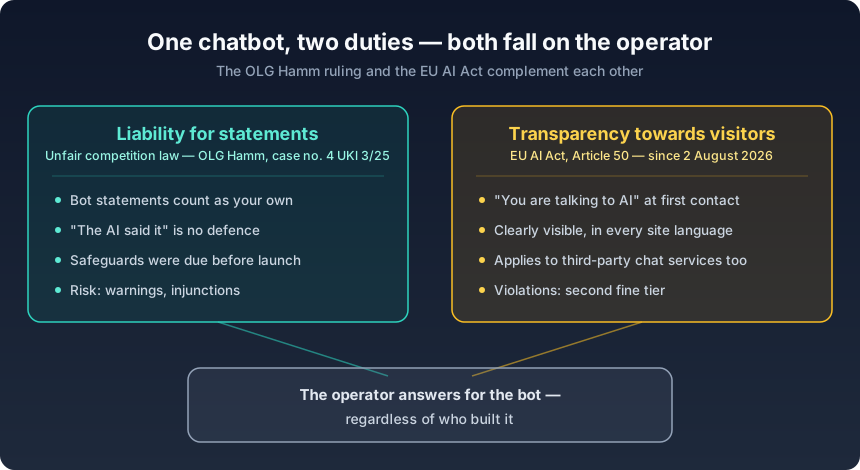 Two duties, one system: liability for statements and disclosure towards visitors both fall on the operator.
The five levers almost everyone leaves unused
The good news: everything the court calls reasonable is achievable with sensible effort. These five levers limit the risk before it arises — not afterwards.
The knowledge base is the liability frame. A bot that answers from a curated set of your own documents — website content, price lists, FAQs — has far fewer opportunities to invent things than one drawing on a language model’s world knowledge. Limiting the answer space to verifiable own sources automatically limits the liability surface.
Lock out dangerous topics from the start. Prices, contract terms, qualifications, commitments — everything that would be actionable in the worst case belongs outside the bot’s autonomous answer space. The most critical categories are known in every company before the first chat goes live.
Define a handover point to humans. A sentence like “my colleague will sort this out with you personally” costs nothing. A bot that hands over to humans when uncertain is not a weak bot — it is a bot with a built-in firewall. The parallel to a new employee hits the mark here: you would not hand them the contract negotiations on day one either.
Ask the dangerous questions before launch. Test exactly the questions where a wrong answer would be expensive: qualifications, availability, prices, guarantees. The ruling sets precautions before launch as the standard — whoever only tests after the first complaint has already missed it.
Disclose at the first interaction. The notice “You are chatting with an AI” — visible, understandable, in every site language — fulfils Article 50 and does not act as a brake; it acts as a signal of honesty.
What it costs not to do this
The honest question is not what these precautions cost, but what their absence costs. First the obvious: a competition-law warning letter ties up time, lawyers, and attention — and once a cease-and-desist declaration is signed, every further word the bot ever says gets scrutinised, for years.
The bigger risk is quieter. Hallucinations are defined by being wrong and convincing at the same time. A bot that confirms a non-existent qualification, a false price promise, or an invented service commitment to a prospect creates a customer relationship on a basis the company never approved. When that surfaces, the damage is not the single false answer — it is trust in every answer that follows. And while a corrected website page is true again quickly, customers remember that something was claimed here and then walked back.
Add the competitive side: chatbots run by competitors who implement these duties cleanly never tire of answering correctly. The difference is not the model — it is the frame the operator sets.
Common mistakes
The generic disclaimer as a safety net. “AI can make mistakes” is not a substitute for precautions — the court explicitly refused to accept that calculation.
World knowledge instead of company knowledge. A bot that wants to answer everything will eventually answer the one question that legally counts with a falsehood. The job description reads: answer questions about the company, not explain the world.
Leaving disclosure to the provider. The chat service may ship with a notice — whether it is visible, timely, and in the right language for your own website’s visitors remains the operator’s responsibility. “The provider should have done that” is not a defence.
Conclusion: onboard it, don’t just install it
The chatbot is no longer a component you install and forget. It talks to customers, in the company’s name, with nobody looking over its shoulder. The OLG Hamm merely put that situation into legal words: the bot is part of the organisation — its word is the company’s word.
That does not mean walking away from chatbots. They remain what they promise: a first point of contact around the clock that takes real load off people. What follows is the insight that you onboard one like a new team member — with a clearly defined job, limited decision latitude, defined handovers, and a training period before it works with customers unsupervised. Onboard it that way, and you get the benefit without the residual risk.
If you want to check whether your existing chatbot meets these duties — or set up an AI assistant on solid legal footing from the start — let’s talk in a no-obligation initial consultation.
Related posts: EU AI Act Article 50 and copyright | Cookie liability 2026 | Local AI and data sovereignty
Lindwurm Digital GmbH — Web development and digital solutions.