
Agentic Commerce: When AI Agents Do More Than Search
The conventional online shop expects a person to search, filter, compare, fill a cart, and pay. AI assistants are changing that journey. They can derive requirements from a conversation, shortlist offers, and prepare individual steps. The next technical step is more significant: the assistant should be able to do more than advise. It should interact with merchants through standardized interfaces.
The Universal Commerce Protocol (UCP) was introduced in early 2026 for that purpose. The open standard aims to create a common language between AI interfaces, merchants, and payment providers. It covers more than product search: discovery, cart, checkout, order status, and returns are all part of the intended lifecycle.
This is not yet a universal new shopping reality. UCP continues to evolve, platforms and merchants still need to implement it, and sensitive purchases require reliable consent. The standard nevertheless shows where digital commerce is heading: part of the purchasing decision and transaction may move out of the shop and into an assistant.
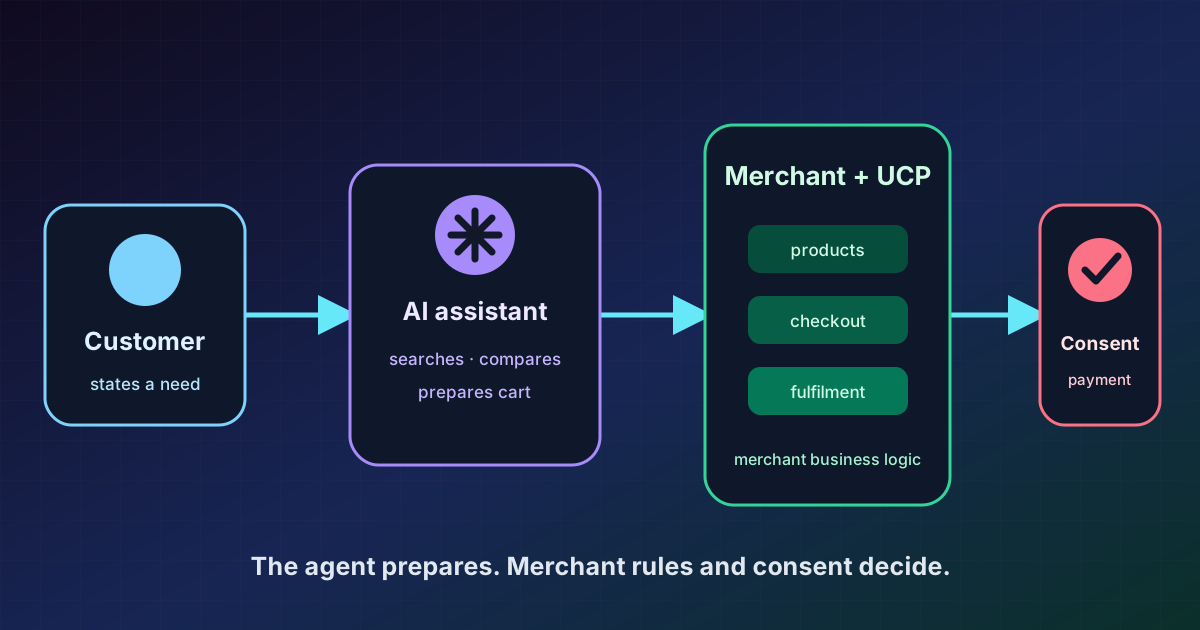 UCP aims to make merchant capabilities discoverable without removing the merchant’s business logic and responsibility.
How agentic commerce differs from a chatbot
A shop chatbot answers questions inside a website. It may know the products, delivery terms, or opening hours. The user still completes the actual order through the shop interface.
Agentic commerce reverses the relationship. The user begins with their assistant and states a goal: “Find three suitable office chairs with short delivery times, check the return terms, and prepare the best cart.” The assistant searches, compares, and communicates with merchant systems. The shop is no longer necessarily the main interface, but it remains the source of product data, availability, prices, rules, and the transaction.
That changes the role of the website. Strong product pages and a clear checkout remain important because people continue to shop directly and agents need visible information. An additional machine-readable commerce layer emerges. It has to communicate not only what a product is, but also which business capabilities exist: search, checkout, discounts, delivery, identity linking, order status, or returns.
Agentic commerce therefore goes beyond Machine Experience. The website is not only understood. The commerce system becomes an executable part of a delegated task.
What UCP aims to standardize
Google describes the Universal Commerce Protocol as an open standard designed to work with existing retail infrastructure. Large commerce, platform, and payment businesses are involved. That list is not proof of universal market readiness. The architecture behind the proposal is what matters.
UCP divides the commerce journey into defined capabilities. A merchant publishes which capabilities it supports. An agent can discover them through a standardized profile at /.well-known/ucp. Potential capabilities include:
- product discovery and selection,
- cart and checkout,
- discounts and fulfilment options,
- identity linking,
- order status and returns,
- supported payment methods.
The interface is not tied to one transport. Capabilities can be exposed through conventional APIs, MCP, or Agent-to-Agent communication. The open UCP repository documents schemas, capabilities, extensions, and conformance tests.
The business idea is straightforward. A merchant should not need a custom integration for every AI interface. An agent should not need to learn a new checkout for every shop. Both sides agree on a common language.
Why the current shop model reaches its limits
Digital commerce platforms are optimized for human navigation. Categories, filters, banners, recommendations, and checkout stages guide shoppers through the range. For agents, this variety is expensive and error-prone. Every shop names attributes differently, models variants differently, and handles availability, discounts, and delivery according to its own rules.
An agent can read interfaces and simulate clicks. That is not enough for a binding order. Prices can change, variants can sell out, taxes and shipping depend on destination, discounts come with conditions, and payment needs demonstrable authorization.
UCP therefore does not try to standardize the visible storefront. It standardizes the communication beneath it. According to the specification, the merchant retains its business logic and remains the Merchant of Record. This matters: agentic commerce should not reduce a merchant to an interchangeable product database controlled by an AI platform.
Whether that promise survives in practice depends on implementation. Whoever controls customer access, offer presentation, and the transaction path gains influence. An open standard reduces technical lock-in, but it does not eliminate platform power.
Four changes merchants should watch
1. Product data becomes a sales interface
In a conventional shop, images, layout, and brand presentation can sometimes conceal incomplete data. An agent needs precise attributes: dimensions, materials, compatibility, delivery time, variants, exclusions, and return rules. If information is missing or contradictory, the agent cannot recommend the product confidently.
Product data management becomes even more directly a sales responsibility. Search engines and marketplaces are no longer the only systems reading the catalogue. Assistants use it to validate requirements and remove products from consideration.
2. Checkout becomes a capability
Checkout is usually a fixed sequence of pages. UCP models it as a defined capability. An agent can create a session, update items, check fulfilment options, and prepare an order for confirmation.
That forces merchants to define state clearly. Is the price final? Which information is missing? When is an order merely prepared, and when is it complete? Which change requires renewed consent? A clearly modelled checkout helps agents but also improves the operation of conventional shops.
3. Consent becomes part of the architecture
An assistant should not be allowed to buy merely because it can technically call a checkout. The central question is what the user actually authorized.
UCP is compatible with the Agent Payments Protocol (AP2). Google’s guide to AI agent protocols describes the division of responsibility: UCP handles what is ordered and from whom; AP2 is intended to demonstrate who approved the purchase and which limits apply.
For merchants, consent, limits, allowed businesses, expiry, and evidence cannot be a final dialog attached to a completed checkout. They belong in the core transaction model.
4. Customer relationships and platform reach need a new balance
When a purchase begins in an assistant, the customer may see less of the shop. Comparison, selection, and parts of checkout can happen outside the merchant’s interface. That removes friction but can weaken brand attachment and the direct customer relationship.
Merchants should ask more than how to support UCP. They need to decide which parts of the offer can be standardized and where advice, configuration, or personal review remains essential. Not every product and purchasing journey suits extensive delegation.
Who is likely to feel the change first
Agentic commerce will not transform every sector at once. Offers with structured data and clear decision rules are likely to benefit first.
Standardized products can be compared through attributes, availability, and price. Spare parts, office supplies, consumables, and clearly configured variants fit more easily than individual one-off products.
Recurring procurement is another strong candidate. When businesses repeatedly purchase familiar categories with known limits, an agent can check stock, request offers, and prepare orders.
Complex catalogues with good data can benefit when an assistant filters precisely. Compatibility, technical attributes, and delivery conditions need to be complete.
Purchases driven by touch, intensive advice, individual planning, or preferences that are difficult to express are less suitable. An agent may still support research and appointment preparation. The binding purchase is likely to remain human-led for longer.
What merchants should review now
Treating UCP as mandatory for every shop would be premature. It is useful, however, to assess the commerce architecture against requirements that remain relevant regardless of the eventual standard.
Product data
- Are important attributes complete and consistent?
- Can variants, availability, and delivery times be queried unambiguously?
- Are exclusions, compatibility, and return rules machine-readable?
- Do product pages, data feeds, and checkout contain conflicting information?
Business logic
- Is responsibility for product information, price calculation, fulfilment, and payment clearly separated?
- Can prices and stock be confirmed in real time?
- Are states and errors defined so external systems can understand them?
- Does the merchant retain control of its rules in embedded journeys?
Consent and security
- Which actions may an agent prepare?
- Which require explicit confirmation?
- How are authorization, changes, and cancellation recorded?
- How is personal data minimized and protected?
- Which limits apply to automated requests and transactions?
Customer experience
- Which purchasing decisions benefit from fewer steps?
- Where does the customer still need advice or visual orientation?
- How do brand, service, and contact remain visible when an assistant mediates?
- What happens after purchase: order status, changes, returns, and support?
This review creates value even if UCP changes or another standard becomes stronger. Sound product data, clearly separated business logic, and reliable consent are foundations of any shop prepared for new sales channels.
Three mistakes businesses should avoid
“We will wait until agents shop everywhere”
Businesses that only react when a platform demands access will work under somebody else’s deadline. Data quality, API readiness, state, and consent cannot be added credibly in a short integration project.
“We need to implement every new interface immediately”
The opposite is equally risky. A developing standard does not justify an uncontrolled rebuild. A small prototype with a defined learning objective is more useful than a large integration without real use or an operating model.
“The website will no longer matter”
Agentic commerce does not make the website obsolete. People continue to check brands, details, evidence, and service directly. Agents also need reliable public information. The website remains the interface for trust, guidance, and brand experience. It simply gains additional machine access paths.
The opportunity cost of remaining unprepared
The greatest disadvantage is not missing an early trend. It is discovering that the commerce architecture cannot connect to new channels.
When product data only exists inside page copy, prices depend on hidden interface logic, and order states are not properly separated, every new sales interface becomes a custom project. This affects more than AI agents. Marketplaces, partner portals, mobile applications, and internal automation suffer from the same weaknesses.
Remaining unprepared therefore means greater integration effort, slower experiments, and stronger dependence on platforms that compensate for missing access with their own import and mediation layers. Merchants with clearly modelled commerce logic can assess new channels without reinventing the whole system.
Conclusion: the shop becomes executable infrastructure
Agentic commerce shifts digital trade from interface alone toward executable infrastructure. An AI assistant should be able not only to describe products but to discover capabilities, prepare a cart, and initiate an authorized purchase.
UCP is a serious proposal for that common language, but it is not yet a settled market standard. Businesses should neither claim a certain future nor dismiss the subject as hype.
The right preparation is unspectacular and valuable: complete product data, clear business logic, documented interfaces, dependable consent, and a website that creates trust even when the first contact begins through an assistant.
If you want to assess whether your shop or digital offer can connect to new sales channels, we can discuss data, processes, and useful prototypes in an initial consultation with no obligation.
Lindwurm Digital GmbH — Web development and digital solutions.